


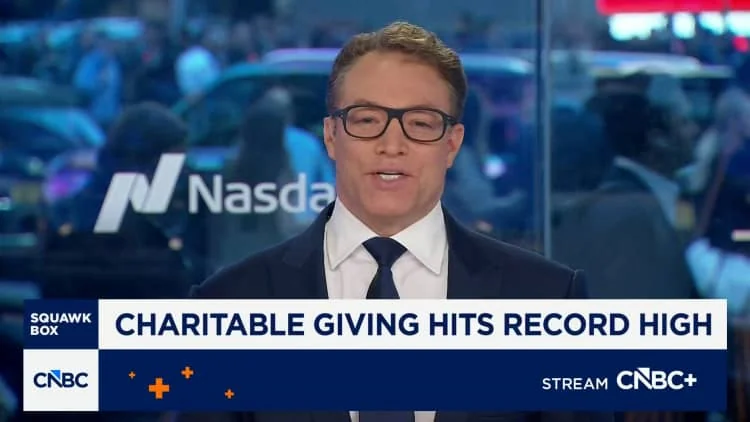
U.S. charitable giving tops $600 billion: mega-donations and bequests drive it
According to a report from the Giving USA Foundation, charitable giving in the U.S. last year is estimated at $617.2 billion, up 5.7% year over year, driven mainly by strong stock market performance. It was the first time in the 60-year history of the annual report that giving topped $600 billion.
Inflation-adjusted, giving rose 3% year over year. By category, individual giving still accounted for the largest share at $394.2 billion, but after inflation adjustment it rose only 1.4%; charitable bequests were estimated at $62.19 billion, up 16.6%.
Bequests may be the latest sign of the Great Wealth Transfer. Cerulli Associates estimates that more than $124 trillion in assets will pass hands by 2048, with about $18 trillion earmarked for charity.
The report’s lead analyst Jon Bergdoll said it is still too early to tell how much of the bequest increase comes from the large-scale wealth handoff. But one thing is clearer: wealthy Americans who are most likely to leave large sums to charity are also the biggest beneficiaries of the stock market rally.
“There is always a close link between charitable bequests and net worth, and net worth is tied to the market,” Bergdoll said. He also noted that market gains are more likely to show up first among people who may make large bequests.
For broader giving, including foundation and corporate donations, the market’s effect is usually slower and milder. Bergdoll expects total giving could rise more clearly given the strength of markets in recent years, but between 2024 and 2025 the S&P 500’s inflation-adjusted gain was 13.4%, while total giving grew by only about a quarter of that, showing a gap between paper wealth and actual giving.
He attributed part of the gap to weak GDP growth and consumer confidence at historic lows. Bergdoll said charitable giving often comes from a sense of financial security; if the economy feels unsettling, that can suppress willingness to give at the individual level.
At the same time, he said he does not want charitable giving to move too closely in step with the stock market. “We don’t want a one-for-one relationship,” he said. Even if the market rises 20%, we do not want giving to fall 20% when markets decline.
Structural impact of mega-donations and bequests
The report also noted that some high-income donors expected to accelerate giving in 2025 to capture tax breaks that may shrink because of policy changes. Bergdoll believes there is indeed some pull-forward in giving, but it is still small relative to total giving. The report estimates that donors in 2025 contributed an extra $1.71 billion to take fuller advantage of expiring tax incentives.
Although U.S. charities received more money, their funding is also becoming more dependent on ultra-high-net-worth donors. That gap is more obvious after economic pressure squeezed middle-class giving. The report estimates that 9 donors contributed $22.32 billion of last year’s total philanthropic giving, with MacKenzie Scott, former wife of Amazon founder Jeff Bezos, accounting for the largest share at $6.65 billion.
These mega-donations - defined as at least 0.1% of total giving - can reshape the charitable landscape from year to year. The report says about one-third of the increase in bequests came from the estate of the late Microsoft cofounder Paul Allen, who created a $3.1 billion fund for science and technology research.
Giving USA Foundation vice chair Gabe Cooper discussed the complicated feelings around mega-donations. On the one hand, he supports more billionaires using their wealth for charity; on the other, he does not want reliance on such large gifts to keep growing, because mega-donation patterns can be far more volatile from year to year.
Cooper also focused on a longer-term issue: the heirs’ choices. “If a billionaire dies and gives $200 million to charity, the remaining $800 million will most likely go to the children,” he said. “So I hope those children make better choices in their charitable decisions.”