

Asian Tech Stocks Rebound as Semiconductor Selloff Shows Signs of Stabilizing
Keywords: Asian tech stocks, Samsung Electronics, SK Hynix, semiconductor market, AI demand, global selloff, Kospi, Tokyo Electron, Advantest, memory chips, Nvidia supply chain
Introduction
After a sharp global risk-off move that battered equities across regions, Asian technology stocks staged a broad but uneven rebound on Wednesday. The recovery came after the previous trading session saw a heavy selloff led by semiconductor and artificial intelligence-related names, with investors reacting to renewed concerns over valuations, cyclical pressure, and the durability of the recent AI-driven rally.
The bounce in Asia was most visible in South Korea, where the country’s two semiconductor giants—Samsung Electronics and SK Hynix—helped lift the broader market. Their rebound was not only a technical relief after steep losses, but also a reminder of how heavily global investors continue to depend on chipmakers as the key barometer for sentiment toward the AI and electronics cycle.
At the same time, the recovery remained selective. While some chip and display-related names recovered, several Japanese technology stocks stayed under pressure, underscoring that the market is still in the midst of a violent repricing rather than a clean return to risk appetite. The pattern suggests that investors are trying to determine whether the recent turmoil reflects a temporary correction or the beginning of a deeper reset in the semiconductor trade.
South Korea Leads the Regional Recovery
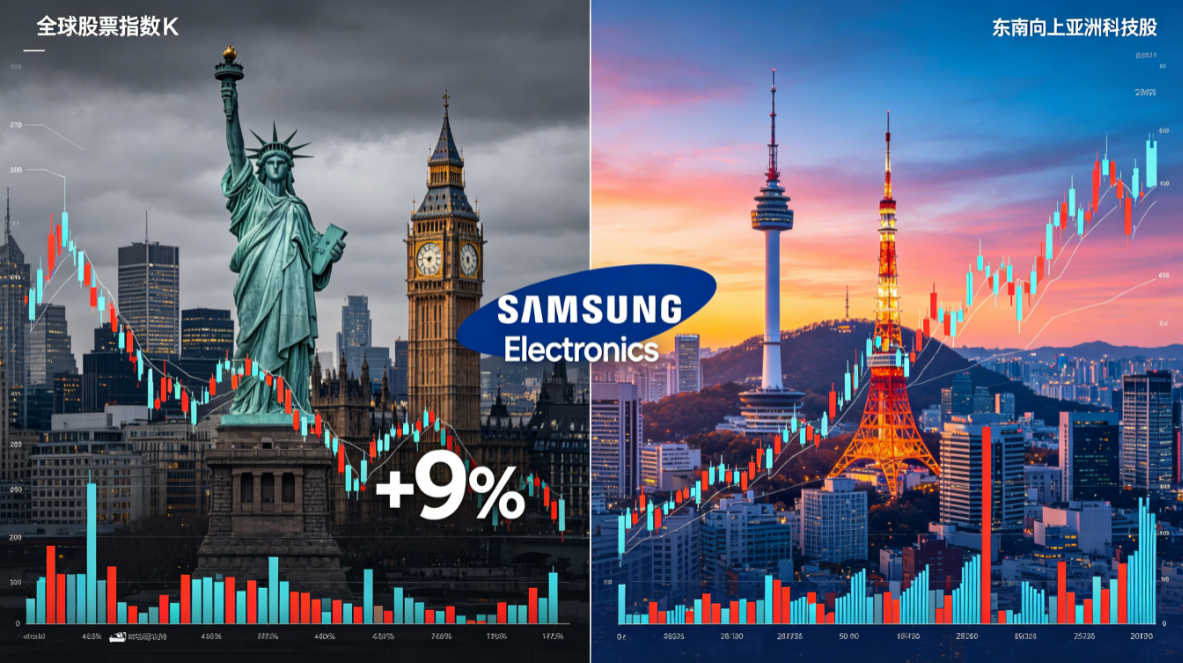
South Korea’s market was the clearest beneficiary of the rebound. Samsung Electronics surged more than 9%, while SK Hynix gained 2.7%, after both stocks had fallen by more than 12% in the previous session. Given their scale and influence, the two companies were largely responsible for pulling the Kospi index up by more than 3% on the day.
This outsized reaction reflects the structure of the Korean market, where semiconductor leaders carry significant index weight and play an essential role in shaping broader investor sentiment. When these stocks fall sharply, they can drag down the entire market; when they recover, they can just as quickly restore confidence. That dynamic was clearly visible in Wednesday’s trading.
Other Korean technology names also participated in the rebound, though not as uniformly. Samsung SDI rose by more than 4%, and Seoul Semiconductor jumped 5%. The performance of these companies suggests that the recovery extended beyond memory chips and into broader electronics and component names. However, the dispersion within the sector also indicates that investors remain selective, favoring companies with stronger near-term fundamentals or more convincing strategic positioning.
The sharp rebound in Samsung Electronics is especially notable because the stock had been among the most closely watched proxies for the global memory chip cycle. Its rally may reflect not just bargain hunting, but also the market’s recognition that the previous day’s selloff had become excessive relative to the underlying earnings outlook.
Japan Remains More Mixed
In Japan, the picture was less uniformly positive. Chip equipment maker Advantest slipped 0.51%, SoftBank Group rose 1.84%, and Tokyo Electron fell 3%. The mixed performance highlights the different ways in which Japanese technology stocks are exposed to the broader semiconductor cycle.
Advantest and Tokyo Electron are closely tied to capital spending trends in the chip industry, and their weakness suggests that investors are still cautious about whether the current AI investment boom can sustain its pace. By contrast, SoftBank’s rise reflects a different set of drivers, including its exposure to technology investments and broader market positioning.
The disparity between South Korea and Japan also shows that investor sentiment is not moving in one direction across the entire region. Instead, the market appears to be recalibrating company by company, segment by segment, depending on exposure to AI demand, memory pricing, equipment orders, and valuation levels.
This kind of divergence is typical during a correction phase. When a sector has rallied sharply over an extended period, any reversal tends to expose differences in business models and earnings sensitivity. In the current environment, semiconductor manufacturers, memory suppliers, and equipment makers are being treated less as a single trade and more as distinct investment cases.
Why the Selloff May Be More About Positioning Than Fundamentals
According to Wedbush Securities analyst Dan Ives, recent field checks across the Asian industrial supply chain, along with observations on corporate AI demand trends, indicate that the sector’s fundamentals are “intact.” His view is important because it separates the current market volatility from the underlying business reality.
Ives argued that the recent plunge in Korean technology stocks may be better understood as a correction after the Kospi’s near-doubling this year, rather than a sign of weakening fundamentals. That interpretation resonates with the broader market backdrop: stocks that have run up aggressively are often the first to be sold when investors rush to reduce risk, even if the long-term narrative remains unchanged.
In other words, the selloff may have been driven more by crowded positioning, profit-taking, and valuation anxiety than by a sudden deterioration in demand. This distinction matters. If fundamentals remain healthy, then the correction may ultimately be temporary, though it could still be severe in the short term.
That said, “fundamentals intact” does not mean volatility will disappear. In highly cyclical sectors such as semiconductors, share prices often move ahead of earnings by a wide margin. When expectations become elevated, even strong underlying demand may not be enough to prevent sharp pullbacks if investors begin to question the speed or scale of future growth.
Wall Street’s Weak Session Added to the Pressure
The rebound in Asia followed a brutal session on Wall Street, where technology stocks extended the global selloff that had started in Asia the day before. The Nasdaq Composite fell 2.2%, and the Philadelphia Semiconductor Index also declined sharply as investors dumped chipmakers and artificial intelligence-related stocks.
The list of losers on Tuesday in the U.S. was broad and severe. Memory chip makers Micron Technology and SanDisk each plunged 13%, while Intel, AMD, and Qualcomm all dropped by more than 5%. The moves were especially striking because they cut across both legacy chip names and companies more closely associated with the AI and high-performance computing theme.
This broad-based weakness suggests that investor concerns extend beyond one company or one product cycle. Instead, the market appears to be reassessing whether the AI investment narrative has become too crowded and too expensive. After a long stretch in which semiconductor stocks were treated as the clearest beneficiaries of the AI boom, even a modest change in sentiment can trigger a rapid de-risking.
The fact that the global selloff began in Asia and then spread to the U.S. also reflects the increasingly interconnected nature of technology markets. Semiconductor supply chains, capital spending plans, and AI demand expectations are now global in scope. As a result, weakness in one region can quickly become a worldwide risk event.
What Investors Are Watching Next
The key question now is whether the recent volatility represents a healthy reset or the start of a more sustained downturn. Several factors will likely shape the answer.
First, investors will watch for evidence that AI-related capital spending remains robust. If cloud providers, data center operators, and major technology platforms continue to commit heavily to chips and infrastructure, that would support the long-term earnings outlook for semiconductor firms.
Second, memory pricing trends will matter. Companies such as Samsung Electronics and SK Hynix are highly sensitive to shifts in DRAM and NAND markets. If pricing stabilizes or improves, it could reinforce the case that the sector’s fundamentals remain firm. If not, the market may conclude that the recent earnings cycle has already peaked.
Third, valuations will stay under scrutiny. Even strong companies can experience prolonged pressure when their share prices rise faster than their earnings power. That is particularly true in a market environment where investors are more cautious about interest rates, macro growth, and geopolitical risk.
Finally, broader market sentiment will remain a decisive factor. The recent correction has shown that when global investors turn defensive, semiconductor stocks are often the first to be sold and the last to recover. Their role as market leaders gives them tremendous upside during risk-on phases, but it also makes them vulnerable when sentiment turns.
Conclusion
Wednesday’s rebound in Asian technology stocks provided an important counterpoint to the previous day’s brutal global selloff, but it did not fully erase the uncertainty that has swept through semiconductor markets. Samsung Electronics and SK Hynix led a strong recovery in South Korea, helping the Kospi rise more than 3%, while Japanese tech stocks presented a more mixed picture.
The broader message from the market is clear: investors are no longer simply buying the AI and chip narrative in a straight line. Instead, they are testing whether the sector’s extraordinary gains have outrun fundamentals. For now, the evidence suggests that underlying demand remains solid, especially in AI-related areas, but price action indicates that sentiment is fragile and positioning remains vulnerable.
In this environment, the semiconductor trade is not breaking down, but it is being re-evaluated. That makes the current pullback less a verdict on the industry’s long-term prospects than a reminder that even the strongest themes can become overstretched. For long-term investors, the challenge is to distinguish between a temporary correction and a structural shift. For the market, the answer will depend on whether earnings, demand, and capital spending can keep pace with the expectations already embedded in stock prices.