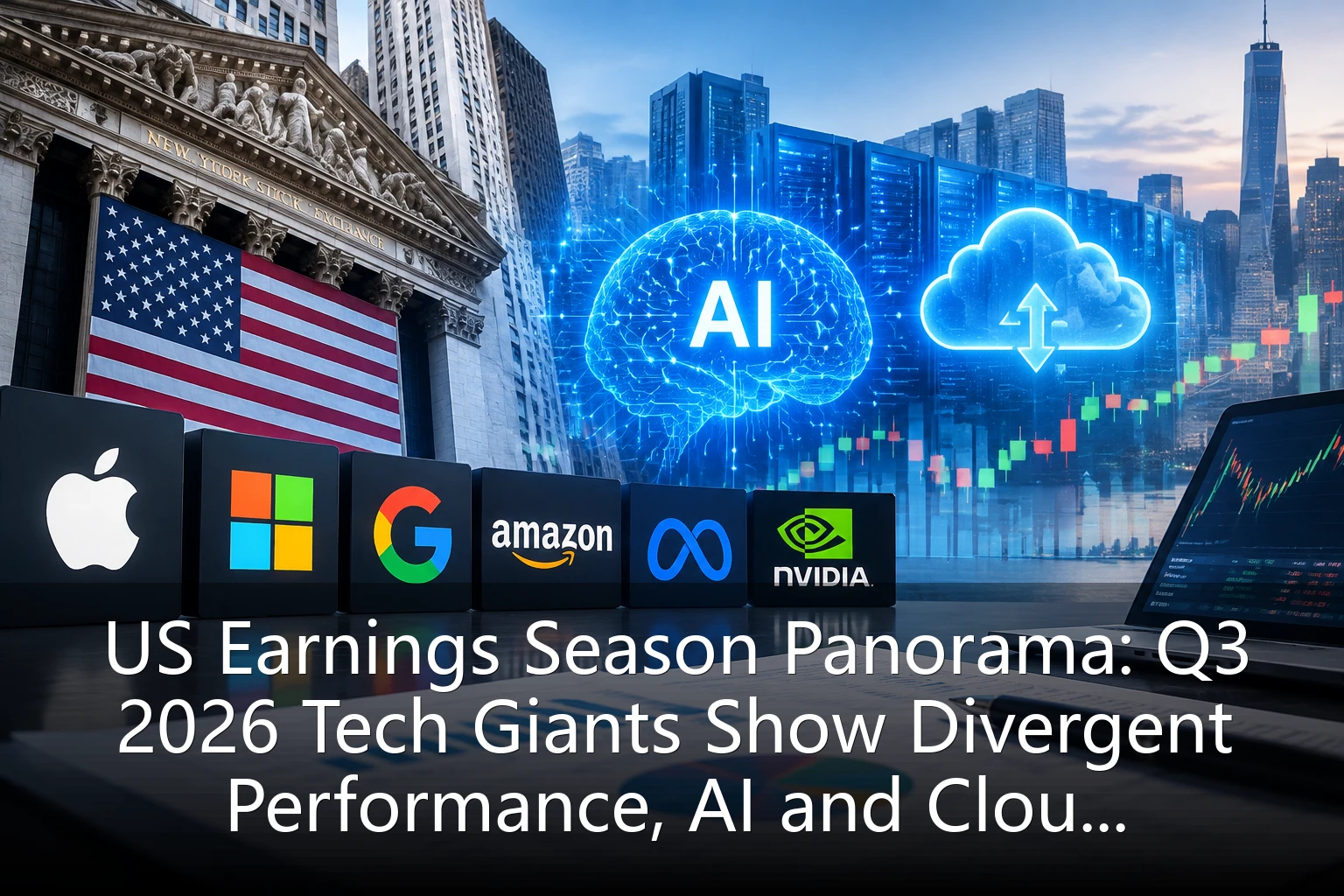



A Panoramic View of Earnings Season: Divergent Performance Among Tech Giants in Q3
The Q3 earnings season for US stocks 2026 is concluding, and the market is showing clear structural differentiation overall. According to the latest data, approximately 85% of S&P 500 constituents have released their Q3 reports. The technology sector remains a focal point of market attention, but its internal performance is vastly varied.
Tech companies centered on artificial intelligence continue to demonstrate robust growth momentum. Nvidia (NVDA) reported a 42% year-over-year revenue increase in Q3, exceeding market expectations, mainly driven by the sustained explosion in AI chip demand. CEO Jensen Huang stated during the earnings call: "The AI revolution is in an accelerating phase, and our data center business will continue to lead the market." Similarly, cloud giant Microsoft (MSFT) saw a 28% growth in cloud services revenue for Q3, with Azure business growth reaching 35%, indicating that enterprise digital transformation needs remain strong.
However, not all tech giants managed to deliver stellar results. Traditional tech giants like Apple (AAPL) reported only a 3% revenue increase in Q3, with iPhone sales declining for the second consecutive quarter. The company's CEO attributed this to "increasing global economic uncertainty" and "cautious consumer spending." Likewise, Meta Platforms (META) saw its advertising business growth slow to 12% in Q3, far below the 28% recorded in the same period last year, indicating bottlenecks in social media growth.
The AI Computing Power Industry Booms, with Hardware Leading the Market
Driven by the AI wave, the computing power industry has emerged as the biggest winner of this earnings season. Besides chip manufacturer Nvidia, data center infrastructure providers have also benefited significantly. Dell (DELL) reported a 31% increase in server business revenue for Q3, and Super Micro Computer (SMCI) saw a massive 68% surge in revenue, demonstrating the strong growth in AI hardware demand.
On the software side, AI application companies also showed strong growth momentum. Adobe (ADBE) reported a 24% increase in Creative Cloud revenue for Q3, with AI features making a significant contribution; Salesforce (CRM) saw a 15% revenue increase in Q3, with AI-driven services being a highlight of growth. Analysts point out that AI is moving from concept to practical application, beginning to create tangible value for enterprises.
It is worth noting that the boom in the AI computing power industry has also brought supply chain tensions. Nvidia warned in its earnings report that the shortage of high-end GPUs might continue until 2027, which will provide related companies with sustained pricing power and profitability.
Traditional Tech Giants Face Growth Bottlenecks and Are Actively Transforming
In stark contrast to the fervor of AI-related companies, traditional tech giants are facing challenges of slowing growth. Despite a 12% increase in service revenue, Apple's second consecutive quarter of declining iPhone sales was not enough to offset the hardware business decline. The company announced plans to further increase investment in AI R&D, planning to invest over $10 billion in AI technology development over the next two years.
Google's parent company Alphabet (GOOGL) saw its Q3 advertising business growth slow to 9%, and YouTube ad revenue grew by 10%, both falling short of market expectations. Company CEO Pichai stated, "We will continue to invest in AI technology to improve advertising efficiency and user experience." Similarly, Amazon (AMZN)'s Q3 cloud business growth slowed to 16%, the lowest since 2016, and the company is actively investing in the AI field, hoping to boost growth through AI services.
Market Reaction and Capital Allocation Strategies in Hong Kong and Taiwan
The market reaction during earnings season showed clear divergence. Stock prices of AI-related companies generally rose after earnings releases; Nvidia's stock rose by 8% in a single day after its report, and Dell rose by 12%. Traditional tech giants, however, performed weakly, with Apple's stock falling by 3% and Google's by 2% after its report.
Investors in Hong Kong and Taiwan responded quickly to this divergence. According to HKEX data, since September, Stock Connect funds have significantly increased their holdings of US tech stocks through ETFs, with Nasdaq 100 ETF (QQQ) net inflows reaching a record $4.5 billion, while S&P 500 ETF (SPY) net inflows were only $1.8 billion. In Taiwan, according to TWSE data, the proportion of foreign capital increasing holdings of US tech stocks through Taiwan-US stock linkage funds reached 65%.
The Dual-Track Allocation Strategy of Hong Kong and Taiwan Capital
Faced with the structural divergence in the US stock market, capital from Hong Kong and Taiwan is adopting a "dual-track" allocation strategy. On one hand, they concentrate investments in leading companies of the AI industry chain, such as Nvidia and Microsoft, through tools like ETFs; on the other hand, they pay attention to valuation recovery opportunities in traditional tech giants, especially after their stock prices have corrected.
An investment director at a major asset management company in Hong Kong stated, "We are optimistic about the long-term development of the AI industry chain, but we also believe that traditional tech giants still have opportunities in the AI transformation. Our strategy is to maintain a high allocation to AI leaders while buying traditional tech stocks with reasonable valuations during dips."
A senior investment advisor in Taiwan pointed out, "Investors from Hong Kong and Taiwan place a greater emphasis on diversification when allocating to US tech stocks, paying attention not only to the performance of leading companies but also to investment opportunities in the upstream and downstream industries. Especially in the current environment of increased market volatility, ETF allocation can effectively reduce single-stock risk."
ETF Allocation as the Main Channel for Hong Kong and Taiwan Capital to Participate in the US Market
As the participation of investors from Hong Kong and Taiwan in the US market has increased, ETFs have become their main channel for allocating to US stocks. Data shows that since September, the scale of net inflows of Stock Connect funds into the US market through ETFs has reached a record $12 billion, a 65% increase compared to the same period last year. The capital scale from Taiwan allocating to US stocks through ETFs also reached $8.5 billion, a year-on-year increase of 52%.
In terms of specific product selection, investors from Hong Kong and Taiwan tend to favor broad-based index ETFs and industry thematic ETFs. Among these, Nasdaq 100 ETF (QQQ), Semiconductor ETF (SMH), and AI thematic ETF (THNQ) are the most favored products. These ETFs not only provide a convenient investment channel but also effectively reduce the risk of selecting individual stocks.
Outlook: Structural Opportunities Led by AI Will Continue
With the gradual release of quarterly reports, the market's outlook for Q4 and 2027 is becoming clearer. Most analysts believe that structural opportunities led by AI will continue, but the market will become more differentiated internally.
Morgan Stanley's latest research report points out that the AI industry chain will continue to lead the market, but valuations are already high, requiring investors to pay closer attention to corporate profitability and growth sustainability. Furthermore, the progress of traditional tech giants in AI transformation will also be a focus of market attention. Goldman Sachs stated that there is still room for Hong Kong and Taiwan capital to allocate to US stocks, especially in the AI and cloud computing sectors. As the global economy gradually recovers, the profit growth of the technology sector is expected to accelerate, bringing better returns to investors from Hong Kong and Taiwan. For investors from Hong Kong and Taiwan, the current market environment presents both opportunities and challenges. On one hand, the structural opportunities brought by the AI revolution are worth paying attention to; on the other hand, increased market volatility and geopolitical risks must be guarded against. Diversified allocation through tools like ETFs, while paying attention to the core competitiveness of companies, will be an effective strategy for dealing with the current market environment.Strategic Recommendations for Hong Kong and Taiwan Investors in the US Stock Market
Based on the current market environment, we offer the following strategic recommendations for Hong Kong and Taiwan investors participating in the US stock market:
- Core Allocation to the AI Industry Chain: Allocate to leading stocks in the AI industry chain through ETFs, focusing on core companies such as Nvidia, Microsoft, and Google, as well as related fields like semiconductors and cloud computing.
- Monitor Traditional Tech Giant Transformations: Closely monitor the progress of traditional tech giants like Apple and Amazon in the AI field, and position in reasonably valued stocks during downturns.
- Diversify Risks Using ETF Tools: Reduce single-stock selection risk and improve investment efficiency by allocating through broad-based index ETFs and thematic industry ETFs.
- Pay Attention to Exchange Rate Risk: Hong Kong and Taiwan investors participating in the US stock market need to monitor the exchange rate fluctuations of the USD against the HKD and TWD, and can reduce risk through currency hedging tools.
- Long-Term Perspective Allocation: The long-term growth logic of the US tech sector remains unchanged, and investors from Hong Kong and Taiwan should maintain a long-term perspective, avoiding short-term market fluctuations from affecting investment decisions.
Overall, the US stock earnings season in the third quarter of 2026 shows clear structural differentiation, with AI-related companies continuing to advance rapidly, while traditional tech giants face growth challenges. Investors from Hong Kong and Taiwan are actively adjusting their allocations through tools like ETFs to seize the structural opportunities in the technology sector. Against the backdrop of the AI revolution, the long-term growth logic of the technology sector remains clear, but the market will be more differentiated internally, requiring investors to pay greater attention to corporate core competitiveness and profitability.